




Knee Support for Nurses, Warehouse Workers, and Long Shifts
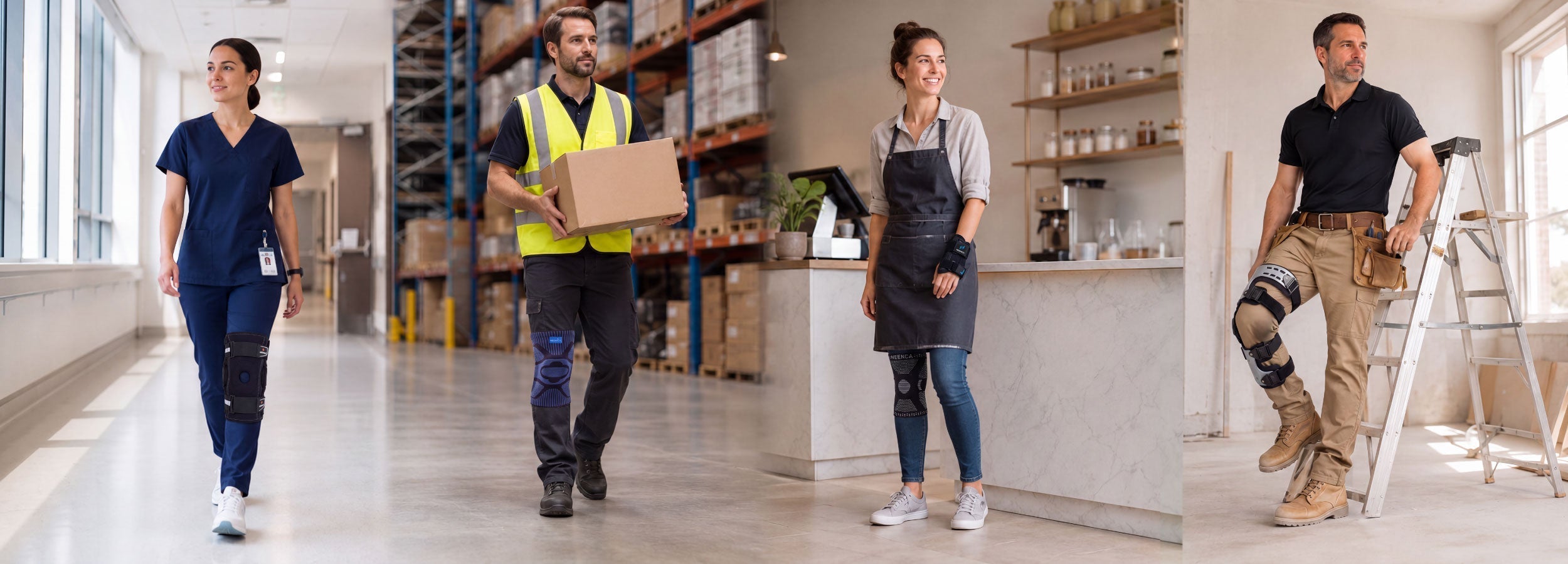
Long shifts are not just “standing all day.” A nurse may walk between rooms, turn quickly, help move patients, climb stairs, and stay on hard floors through a long shift. A warehouse worker may lift, carry, scan, push carts, climb steps, and walk across concrete all day. A retail associate may stand in one place for long periods, then suddenly bend, reach, or restock shelves.
Those are different jobs, but they often lead to the same question: what kind of knee support actually makes sense for a long workday?
The answer is not always the thickest brace or the most rigid support. For many long-shift workers, the better choice is knee support that feels secure, stays in place, fits under work clothing, allows natural movement, and can be worn comfortably for the hours you actually need it.
This guide explains how nurses, warehouse workers, retail staff, food service workers, teachers, delivery teams, and other people who spend long hours on their feet can choose knee support by job type and movement pattern.
This article is for general educational purposes only and is not a substitute for professional medical advice, diagnosis, or treatment. If you have severe pain, sudden swelling, numbness, tingling, instability, locking, a recent injury, circulation concerns, or difficulty bearing weight, speak with a qualified healthcare professional before relying on any brace or support product at work.
Why Long Shifts Feel Different From a Normal Walk
A long shift is not the same as taking a walk around the block. At work, the body often has less freedom to change pace, rest, sit, or choose the surface underfoot. You may be standing on tile, concrete, commercial flooring, or anti-slip surfaces for hours. You may also repeat the same motions again and again without noticing how much they add up.
For the knees, long-shift demand usually comes from a combination of factors:
- Standing in one position for long periods
- Walking on hard floors
- Repeated stairs, bending, squatting, or kneeling
- Lifting, carrying, pushing, or pulling
- Long hours with limited recovery time
- Footwear that may not match the work surface
- Workstations that make posture changes difficult
That is why knee support should not be chosen in isolation. A brace can help provide a more supported feel, but workday comfort also depends on footwear, floor conditions, task variation, breaks, strength, hydration, sleep, and how the job is organized.
For a broader overview of standing-related support, you can also read Best Knee Support for Standing All Day.
Start With the Job Pattern, Not the Product
Before choosing a knee brace, look at what your shift actually requires. Two people may both say they “stand all day,” but their knees may be doing completely different work.
| Work Pattern | Common Examples | Support Priority |
|---|---|---|
| Mostly standing in place | Cashiers, reception desks, production lines, some food service roles | Comfortable compression, footwear, floor support, position changes |
| Standing plus frequent walking | Nurses, teachers, retail staff, hospital teams, event staff | Low-profile support, breathability, anti-slip fit |
| Walking plus lifting or carrying | Warehouse, logistics, delivery, stockroom, trade work | More secure support, side structure, durability, flexible movement |
| Standing plus bending, squatting, or kneeling | Construction, maintenance, stocking, cleaning, childcare, mechanics | Flexible movement, patella-area comfort, secure placement |
If you are not sure which support direction fits your workday, use the NEENCA Knee Brace Finder before comparing individual products.
Knee Support for Nurses and Healthcare Workers
Nurses and healthcare workers rarely just stand still. A typical shift can include walking between rooms, standing at workstations, assisting patients, bending, reaching, turning, and responding quickly when something changes. Support needs to work with that pace.
For nurses, caregivers, dental staff, physical therapy aides, pharmacy staff, and other healthcare workers, the most practical knee support features are usually:
- Low-profile fit: easier to wear under scrubs or work pants.
- Breathable knit: important during long, warm shifts.
- Secure compression: supportive without feeling restrictive.
- Anti-slip design: helps reduce constant readjustment.
- Flexible bending: useful for stairs, patient assistance, and quick transitions.
A bulky brace may feel supportive at first, but if it rubs under scrubs, slides during walking, or feels hot by mid-shift, it is unlikely to become part of a realistic daily routine.
For this group, start with the question: Do I need light compression, or do I need a more secure brace feel for repeated movement?
Knee Support for Warehouse and Logistics Workers
Warehouse and logistics work often combines long walking distances with lifting, carrying, stairs, picking, packing, scanning, pushing carts, and standing on concrete. The support needs are usually more dynamic than a desk or retail station.
For warehouse workers, stockroom teams, fulfillment staff, delivery workers, and logistics employees, useful knee support features often include:
- Secure fit during walking: the brace should not slide with every aisle or route.
- Side support: helpful for users who want a more structured feel during repeated movement.
- Breathability: important in warm warehouses or during fast-paced shifts.
- Durability: the product should tolerate repeated use and movement.
- Comfort during bending: especially for picking items from low shelves or loading work.
Concrete floors can make lower-body fatigue more noticeable. Knee support may help the joint feel more secure, but footwear, insoles, floor mats, carts, lifting mechanics, and workload planning still matter.
Knee Support for Retail, Food Service, and Front-of-House Work
Retail and food service workers often deal with a different problem: not always heavy lifting, but hours of standing in limited space. Cashiers, baristas, hosts, kitchen staff, servers, salon workers, and front-desk teams may stand for long periods with short bursts of movement.
In this setting, the best knee support is usually something you will actually wear all shift. That means:
- Not too bulky under uniforms
- Not too hot during active hours
- Comfortable around the back of the knee
- Secure enough for short walking bursts
- Easy to pair with supportive shoes
For workers who stand mostly in one place, the first upgrade may not always be a stronger brace. It may be better footwear, anti-fatigue mats, more position changes, and a knee support product that provides light-to-moderate compression without limiting movement.
Knee Sleeve, Stabilized Brace, or More Structured Support?
Long-shift workers often get stuck because “knee support” can mean many different things. A sleeve, a stabilized brace, and a more structured brace are not interchangeable.
| Support Type | Best Fit | What It Offers | What to Watch |
|---|---|---|---|
| Compression Sleeve | Light daily support, mostly standing or walking | Flexible compression, low-profile wear, easy movement | Less structure for active or loaded work |
| Supportive Compression Brace | Long shifts with walking, stairs, bending, or active movement | Compression plus patella-area support, side stabilizers, and a more secure feel | Must still be comfortable for all-day wear |
| Highly Structured Support | Specific support needs, often with professional guidance | More controlled support direction and adjustability | May be more specialized and less practical for every job |
For most long-shift workers, the goal is not maximum restriction. The goal is a stable, comfortable support level that matches the actual job.
How to Choose by Support Level
Light Support for Standing and Walking
If your shift is mostly standing, walking, and light movement, a lighter supportive compression option may be enough. The priority is comfort, breathability, and a fit that does not distract you during the day.
For users who want a lighter supportive compression option with kneecap cushioning and flexible side stabilizers, the NEENCA ACE-50 Professional Knee Brace is one product direction to compare.
More Support for Active Long Shifts
If your shift includes stairs, fast walking, bending, repeated movement, or carrying items, you may prefer a more supportive compression brace. This type of product can feel more secure than a simple sleeve while still allowing natural workday movement.
The NEENCA ACE-51 Professional Knee Brace is designed with compression, patella support, flexible side stabilizers, breathable knit fabric, and anti-slip construction for active daily movement support.
Targeted Compression for Active Workdays
Some workers want a support option that feels more targeted than a basic sleeve but still flexible enough for walking, standing, light training, and daily routines. This is where support shape, kneecap cushioning, and side stabilizer design become important.
For users who want targeted compression with patella cushioning and flexible side stabilizers, the NEENCA ACE-53 Professional Knee Support is another option to compare for active workdays, gym training, walking, and long hours on your feet.
Fit Is the Difference Between Helpful and Annoying
A knee brace that slips every hour will not help your workday. A brace that is too tight can become uncomfortable before the shift is halfway over. Fit matters more during long shifts because small problems become bigger with time, sweat, heat, and repeated movement.
A good workday fit should:
- Stay centered around the kneecap area
- Feel snug without cutting into the skin
- Allow walking, stairs, bending, and sitting breaks
- Not bunch behind the knee
- Not cause numbness, tingling, coldness, or discoloration
- Still feel comfortable after several hours, not only when first putting it on
Before choosing a size, use the NEENCA Find Your Size guide and follow the product-specific measurement instructions. Do not choose a knee brace only by clothing size, height, or weight.
What Else Matters Besides the Knee Brace?
Knee support is only one part of long-shift comfort. If the rest of the work setup is poor, a brace may not be enough.
Footwear
Shoes affect how force travels through the foot, ankle, knee, hip, and back. Long-shift workers should pay attention to cushioning, fit, traction, arch support, and whether the shoe still has enough structure after months of use.
Floor Surface
Hard flooring can increase fatigue over time. In fixed standing workstations, anti-fatigue mats may be useful when they are properly selected and placed. They should not be so soft that the worker feels unstable.
Movement Variation
Standing still is often harder than alternating between standing, walking, sitting, and changing posture. When possible, rotate tasks, take short position-change breaks, and avoid locking the knees for long periods.
Workstation Setup
Counter height, reach distance, cart height, shelf position, and lifting setup can all change how much stress the body absorbs during the day. A brace cannot correct a badly designed work process.
Strength and Recovery
General strength, conditioning, sleep, hydration, and recovery can all affect how your body handles repeated workday demand.
Red Flags: When Knee Support Is Not Enough
A brace should never be used to hide warning signs. Long-shift workers are often good at pushing through discomfort, but some symptoms should not be ignored.
Stop relying on self-management and seek professional guidance if you notice:
- Sharp or sudden knee pain
- Swelling that appears suddenly or keeps returning
- A knee that gives way, locks, or catches
- Numbness, tingling, coldness, or color changes
- Difficulty bearing weight
- Pain after a fall, twist, or workplace incident
- Symptoms that worsen throughout the shift
- Discomfort that interferes with sleep or normal movement
If symptoms appear while wearing a brace, remove or adjust it. If the symptoms continue, get qualified advice.
How to Build a Practical Long-Shift Support Plan
The most useful plan is simple enough to follow on a real workday.
| Step | What to Do | Why It Matters |
|---|---|---|
| 1 | Identify your main work pattern | Standing, walking, lifting, and kneeling require different support choices |
| 2 | Choose support level | Light compression, supportive brace, or more structured support should match real demand |
| 3 | Measure carefully | Fit controls slipping, comfort, and all-day wearability |
| 4 | Test during a shorter shift or lower-demand day | Do not wait for your hardest shift to discover fit problems |
| 5 | Review shoes, flooring, breaks, and task setup | Knee support works best as part of a broader workday comfort strategy |
To compare broader daily support options, browse NEENCA Everyday Support.
Final Thoughts
The best knee support for nurses, warehouse workers, retail staff, food service teams, and other long-shift workers is not always the most restrictive brace. It is the support that fits your job, stays comfortable, moves with you, and makes sense for the way you actually work.
For mostly standing roles, flexible compression may be enough. For active long shifts with walking, stairs, bending, lifting, or repeated movement, a supportive compression brace may provide a more secure feel. For more specialized support needs, product choice should be made carefully and, when appropriate, with professional guidance.
Most importantly, think beyond the brace. Shoes, flooring, breaks, workload, strength, recovery, and work design all affect how your knees feel by the end of a shift.
Frequently Asked Questions
What is the best knee support for nurses?
The best knee support for nurses is usually low-profile, breathable, secure, and comfortable under scrubs. Some nurses prefer light compression, while others may choose a supportive compression brace if their shift includes frequent walking, stairs, bending, or patient-assistance movement.
What kind of knee brace is good for warehouse workers?
Warehouse workers often need a brace that stays secure during walking, lifting, carrying, and bending. A supportive compression brace with anti-slip construction and side support may be worth comparing, especially for active long shifts.
Can I wear knee support for a full shift?
Some people wear knee support for long shifts, but comfort and fit are critical. It should feel snug, not restrictive. Remove or adjust it if you notice numbness, tingling, coldness, discoloration, unusual pressure, or increasing discomfort.
Is a knee sleeve enough for standing all day?
A knee sleeve may be enough if you mainly want light compression and low-profile support. If your job involves stairs, lifting, bending, fast walking, or repeated movement, you may want to compare a more supportive brace.
Should I choose ACE-50, ACE-51, or ACE-53 for long shifts?
Choose ACE-50 if you want the lightest, softest, and most breathable ACE option for daily wear. Choose ACE-51 if you prefer thicker, more secure compression with a more comfortable material feel and a stronger wrap while still prioritizing comfort and material quality. Choose ACE-53 if you want a similar thicker, firmer compression feel to ACE-51, but with better value at a slightly lower price. All three models include a contoured patella gel pad, flexible side stabilizers, and compression support, so the right choice depends mainly on wearing feel, breathability, material comfort, support preference, and budget.
Can a knee brace prevent work injuries?
No knee brace can guarantee injury prevention. A brace can provide support and comfort, but footwear, floor conditions, lifting technique, task design, recovery, and professional guidance are also important.
References
- Waters TR, Dick RB. Evidence of Health Risks Associated with Prolonged Standing at Work and Intervention Effectiveness. Rehabilitation Nursing. 2015.
https://pmc.ncbi.nlm.nih.gov/articles/PMC4591921/ - National Institute for Occupational Safety and Health. Prolonged Standing at Work. NIOSH Science Blog / CDC. 2014.
https://www.cdc.gov/niosh/bulletin/2014/standing.html - Canadian Centre for Occupational Health and Safety. Working in a Standing Position - Basic Information.
https://www.ccohs.ca/oshanswers/ergonomics/standing/standing_basic.html - Canadian Centre for Occupational Health and Safety. Foot Comfort and Safety at Work.
https://www.ccohs.ca/oshanswers/prevention/ppe/foot_com.html - Canadian Centre for Occupational Health and Safety. Anti-fatigue Mats.
https://www.ccohs.ca/oshanswers/ergonomics/mats.html - Stolt M, Suhonen R, Virolainen P, Leino-Kilpi H. Foot and Ankle Disorders in Nurses Exposed to Prolonged Standing Environments: A Scoping Review. Workplace Health & Safety. 2023.
https://pmc.ncbi.nlm.nih.gov/articles/PMC9989230/ - National Institute for Occupational Safety and Health. About Ergonomics and Work-Related Musculoskeletal Disorders. CDC / NIOSH. 2023.
https://www.cdc.gov/niosh/ergonomics/about/index.html


Laisser un commentaire
Ce site est protégé par hCaptcha, et la Politique de confidentialité et les Conditions de service de hCaptcha s’appliquent.