


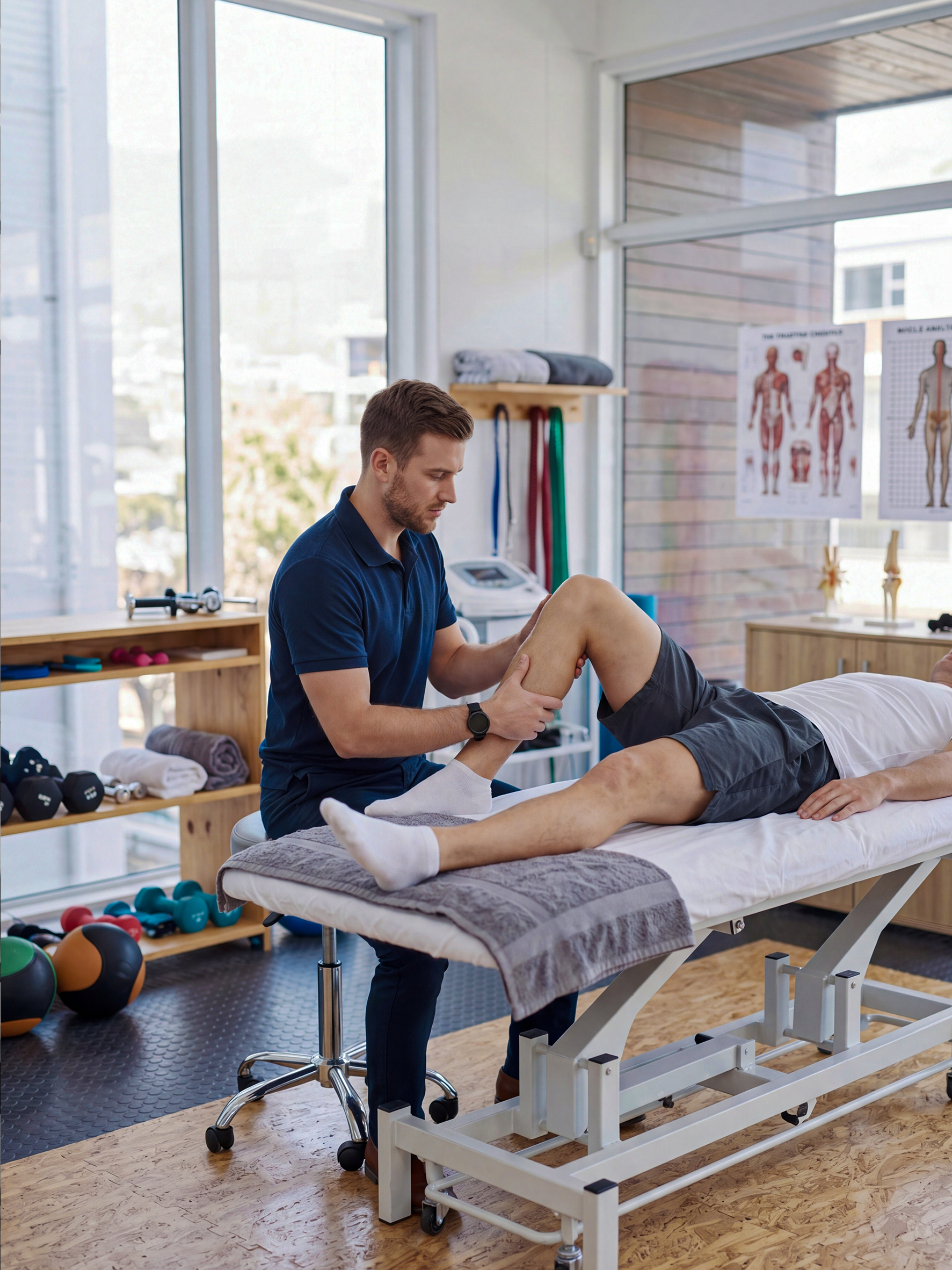


Artikel: Knee Support After a Meniscus Issue: What to Know Before Choosing a Brace

Knee Support After a Meniscus Issue: What to Know Before Choosing a Brace
A “meniscus issue” can describe very different situations. Some people are dealing with a recent twisting injury, some have age-related or degenerative meniscal changes, and others are recovering after meniscus surgery. Those situations should not be treated as if they require the same knee brace.
Before choosing a brace, the most important question is not “Which brace gives the most support?” It is what stage are you in, what has actually been diagnosed, and what do you want the brace to help you do? A brace may provide compression, external support, or a more secure feeling during movement, but it does not repair a torn meniscus and it should not replace evaluation, rehabilitation, or post-operative instructions.
Quick Answer: What Should You Know Before Choosing a Brace?
Use this decision order:
- Recent injury without a diagnosis: prioritize evaluation if the knee is locked, significantly swollen, difficult to bear weight on, repeatedly giving way, or unable to fully straighten.
- Nonoperative management: a brace may be considered for symptom management or an improved perception of stability.1
- After meniscus surgery: follow the surgeon or rehabilitation team’s instructions. Weight-bearing limits, range-of-motion restrictions, and brace use vary by procedure and tear pattern.2
- Everyday activity after symptoms have settled: choose the lightest level of support that stays secure, feels comfortable, and matches the activity you actually need to do.
That means a flexible stabilized compression brace may suit someone who wants lower-profile daily support, while an adjustable hinged brace may suit someone who intentionally wants more side structure. Neither should be presented as a universal “meniscus brace.”
First Identify the Meniscus Situation
Current guidance separates acute traumatic tears, degenerative meniscal lesions, and post-surgical rehabilitation because the management questions are different.
Recent or traumatic meniscus injury
The American Academy of Orthopaedic Surgeons’ 2024 guideline covers the diagnosis and management of acute isolated meniscal injuries. It specifically does not apply to chronic or degenerative tears, re-tears, root tears, or meniscal injuries that occur with other major knee injuries.3
If your symptoms began after a twist, pivot, deep bend, or direct impact and you have not been evaluated, the priority is understanding the injury rather than choosing the strongest brace online.
Degenerative meniscal changes
Degenerative meniscal lesions are more common in middle-aged and older adults and may occur alongside osteoarthritis or other age-related knee changes. The 2025 EU-US consensus recommends nonoperative treatment, including rehabilitation, as the first-line approach for degenerative meniscal lesions, with surgery considered later for selected cases that remain symptomatic.1
A 2025 randomized trial in The New England Journal of Medicine involving adults with knee pain, osteoarthritis, and a degenerative meniscal tear found that adding supervised physical therapy or adherence text messages was not superior to a structured home-exercise program for the primary pain outcome at three months.4 The practical point is not that rehabilitation is unnecessary; it is that an exercise-based management plan can remain central and does not automatically require surgery or a heavy brace.
After meniscus surgery
Meniscectomy, meniscus repair, and meniscus reconstruction do not share identical rehabilitation rules. The 2025 ESSKA-AOSSM-AASPT consensus states that rehabilitation should reflect the tear pattern, procedure performed, tissue quality, weight-bearing status, range-of-motion limits, and progression milestones.2
A consumer brace guide should therefore never override a surgeon-prescribed brace, a locked range-of-motion setting, a weight-bearing restriction, or a procedure-specific rehabilitation protocol.
What Can a Knee Brace Realistically Do?
A knee brace can provide external support. Depending on the design, it may add compression, patella cushioning, flexible side reinforcement, or more adjustable side structure.
For nonoperatively managed degenerative meniscal lesions, the 2025 EU-US consensus states that knee bracing can be considered for symptom management and/or an improved perception of joint stability.1
That evidence boundary matters. A brace should not be described as:
- healing or repairing meniscal tissue;
- guaranteeing that a tear will not worsen;
- making surgery unnecessary;
- replacing strengthening or rehabilitation;
- making return to sport automatically safe.
Which Brace Style Should You Compare?
The most useful way to compare brace types is not “weak versus strong.” It is flexibility versus structure.
| What You Want | Brace Style to Compare | Main Tradeoff |
|---|---|---|
| Low bulk and flexible daily support | Compression or lightweight stabilized brace | Less adjustability and less rigid side structure |
| A firmer wrap around the knee | Thicker stabilized compression | More material and potentially more heat |
| More adjustable side structure | Hinged or strap-adjustable brace | More bulk and hardware |
| Post-operative protection or controlled ROM | Only the brace specified by the care team | Protocol-specific restrictions take priority |
If you need a fuller explanation of the difference between sleeve-style and structured braces, see Knee Sleeve vs Knee Brace: What’s the Difference?.
Lightweight stabilized compression
A stabilized compression brace keeps the fit relatively close to the leg while adding features such as patella cushioning and flexible side stabilizers. This style can be practical for users who want support during walking, errands, work, or routine movement without moving into a rigid hinged design.
The NEENCA ACE-50 is the lighter, softer, more breathable option in the main ACE range. It uses a contoured patella gel pad, flexible side stabilizers, and a lower-profile compression fit. It should be treated as an everyday support option, not as a post-operative immobilizer or a device that repairs meniscal tissue.
Firmer stabilized compression
Some users prefer a more noticeable wrap around the knee while still keeping a flexible sleeve-style design. The ACE-51 uses thicker, more secure compression than ACE-50, along with patella cushioning and flexible side stabilizers.
That difference is primarily about wearing feel and support preference. Firmer compression should not be interpreted as a more effective “treatment” for a meniscus tear.
Hinged or strap-adjustable support
A hinged brace adds more side structure and more adjustment. The NEENCA HX042/HX035 uses removable side hinges and front-crossing X-straps, creating a firmer and more adjustable fit than a pull-on sleeve.
This category may be worth comparing if you deliberately want more side structure or if a fixed pull-on sleeve does not provide the fit you prefer. HX042/HX035 is not a rigid immobilizer or range-of-motion post-operative brace, so it should not replace a prescribed surgical brace.
After Meniscus Surgery, the Protocol Comes First
Post-surgical brace use is where a general shopping guide needs the clearest boundary.
The 2025 post-surgical consensus states that rehabilitation after meniscus repair should be progressed according to both time-based and criterion-based milestones. Restrictions can differ between vertical tears and more complex, radial, root, or horizontal repairs.2
The same consensus reports a lack of evidence for a universal bracing recommendation after meniscus reconstruction; brace use can depend on surgeon preference and other procedures performed at the same time.2
So if you have undergone meniscus repair, reconstruction, or another knee procedure, do not replace a prescribed post-operative brace with a consumer compression sleeve or hinged support simply because the consumer brace feels easier to wear.
For Nonoperative Management, Rehabilitation Still Does the Long-Term Work
The 2025 international consensus recommends rehabilitation that may include range-of-motion work, progressive knee and hip strengthening, neuromuscular training, and home exercise for nonoperatively managed degenerative meniscal lesions.1
A 2024 systematic review and network meta-analysis of 10 randomized trials found that physical therapist interventions based on exercise produced comparable or better short-term outcomes than arthroscopic partial meniscectomy for nontraumatic degenerative meniscal pathology, supporting conservative management as a first-line approach.5
Long-term evidence points in the same direction. The 2025 10-year follow-up of the OMEX randomized trial found no clinically relevant differences in patient-reported outcomes or knee muscle strength between arthroscopic partial meniscectomy and exercise therapy for degenerative meniscal tears, while both groups maintained improvements over time.6
The role of a brace is therefore better framed as supporting activity while rehabilitation addresses strength, motion, and control.
How Fit Changes the Decision
A product labeled “meniscus support” is not useful if it slides, pinches, or interferes with normal movement. For day-to-day use, the brace should remain centered, allow comfortable flexion and extension, and avoid repeated twisting or bunching.
Do not choose a size based only on height, body weight, or pants size. Use the measurement instructions for the specific model. If a brace repeatedly slips, do not keep solving the problem by tightening it indefinitely.
For detailed sizing and tightness guidance, read How Tight Should a Knee Brace Be?.
How to Compare NEENCA Options
There is no single NEENCA model that should be called “the meniscus brace.” A more useful approach is to compare the amount of structure and the wearing feel you actually want.
| Option | Support Style | Consider It If... |
|---|---|---|
| ACE-50 | Lightweight stabilized compression | You prioritize lower bulk, breathability, and flexible everyday support. |
| ACE-51 | Thicker stabilized compression | You prefer a firmer wrap while still using a flexible sleeve-style brace. |
| HX042/HX035 | Adjustable hinged support | You intentionally want more side structure and front-crossing strap adjustment. |
If you are choosing support for ordinary activity and are still unsure which structure fits your preference, use the NEENCA Knee Brace Finder. If you are post-operative, follow your care team’s brace instructions instead of using the Finder to replace a prescribed device.
Return to Sport Is Not a Brace Decision
Being comfortable in a brace does not mean the knee is ready for running, pivoting, jumping, or cutting.
The 2025 EU-US consensus recommends that return to sport after a meniscus injury or surgery be both criterion-based and time-based. Relevant criteria include range of motion, joint swelling, quadriceps and hamstring function, coordination, stabilization tasks, and psychological readiness.1
A brace may be part of the support setup, but it should not be used as proof that the knee is ready for unrestricted sport.
When Evaluation Matters More Than Buying a Brace
Get professional assessment before relying on an online brace guide if you have:
- a recent twisting or traumatic knee injury with significant swelling;
- a knee that is locked or cannot fully straighten;
- repeated giving-way or major instability;
- difficulty bearing weight;
- rapidly worsening symptoms;
- new symptoms after a recent surgery or procedure.
The AAOS acute meniscus guideline is specifically focused on diagnosing and managing acute isolated meniscal injuries, reinforcing that a recent traumatic problem should not be reduced to a generic brace-shopping question.3
Frequently Asked Questions
Can I wear a knee brace only during the activities that make my knee feel less secure?
For nonoperative daily support, some users prefer to wear a brace only for selected activities such as longer walks or work. The brace should still fit correctly and be appropriate for your situation. Post-operative users should follow their prescribed schedule instead.
Does a meniscus brace need an open patella?
No. Open-patella and closed-patella designs are simply different constructions. The better choice depends on overall fit, comfort, support style, and whether the brace stays correctly positioned during movement.
Can I switch from a prescribed post-op brace to a regular hinged brace when I start feeling better?
Not without approval from the clinician managing your rehabilitation. A prescribed post-operative brace may be controlling range of motion or protecting a specific repair, while a consumer hinged brace may not provide the same function.
Final Takeaway
“Meniscus issue” is too broad to point to one universal brace. A recent traumatic injury, a degenerative meniscal lesion, and post-surgical recovery each require different decision-making.
For nonoperative daily support, lightweight stabilized compression may suit users who prioritize flexibility and breathability. Firmer compression adds a more noticeable wrap. Hinged designs add side structure and adjustment. After surgery, however, the rehabilitation protocol takes priority over general product-selection advice.
The strongest recent evidence supports rehabilitation as a central part of meniscus management, while the 2025 international consensus allows bracing to be considered as a support tool in selected nonoperative situations without presenting it as a repair or cure.1, 5
Medical disclaimer: This article is for general educational purposes only and is not a substitute for medical advice, diagnosis, or treatment. Consult a qualified healthcare professional for a recent injury, persistent or worsening symptoms, locking, significant swelling, difficulty bearing weight, post-surgical guidance, or questions about returning to sport.
References
- Prill R, Ma CB, Wong SE, Beaufils P, Monllau JC, Arhos EK, et al. The formal EU-US Meniscus Rehabilitation 2024 Consensus: An ESSKA-AOSSM-AASPT initiative. Part II—Prevention, non-operative treatment and return to sport. Knee Surgery, Sports Traumatology, Arthroscopy. 2025;33(8):3014-3024.
- Pujol N, Giordano AO, Wong SE, Beaufils P, Monllau JC, Arhos EK, et al. The formal EU-US Meniscus Rehabilitation 2024 Consensus: An ESSKA-AOSSM-AASPT initiative. Part I—Rehabilitation management after meniscus surgery. Knee Surgery, Sports Traumatology, Arthroscopy. 2025;33(8):3002-3013.
- American Academy of Orthopaedic Surgeons. Clinical Practice Guideline for the Management of Acute Isolated Meniscal Pathology. AAOS. 2024.
- Katz JN, Collins JE, Bisson L, Jones MH, Irrgang JJ, Selzer F, et al. A Randomized Trial of Physical Therapy for Meniscal Tear and Knee Pain. New England Journal of Medicine. 2025;393:1694-1703.
- Solsona-Carcas D, Trenado-Molina J, Buesa-Estéllez A, López-Royo MP, Bellosta-López P. Physical Therapist Interventions Versus or Combined With Surgical Treatment in Nontraumatic Degenerative Meniscal Pathology: A Systematic Review and Network Meta-Analysis. Physical Therapy. 2024;104(5):pzae007.
- Berg B, Roos EM, Englund M, Kise NJ, Engebretsen L, Eftang CN, Risberg MA. Arthroscopic Partial Meniscectomy Versus Exercise Therapy for Degenerative Meniscal Tears: 10-Year Follow-Up of the OMEX Randomised Controlled Trial. British Journal of Sports Medicine. 2025;59(2):91-98.



Hinterlasse einen Kommentar
Diese Website ist durch hCaptcha geschützt und es gelten die allgemeinen Geschäftsbedingungen und Datenschutzbestimmungen von hCaptcha.