




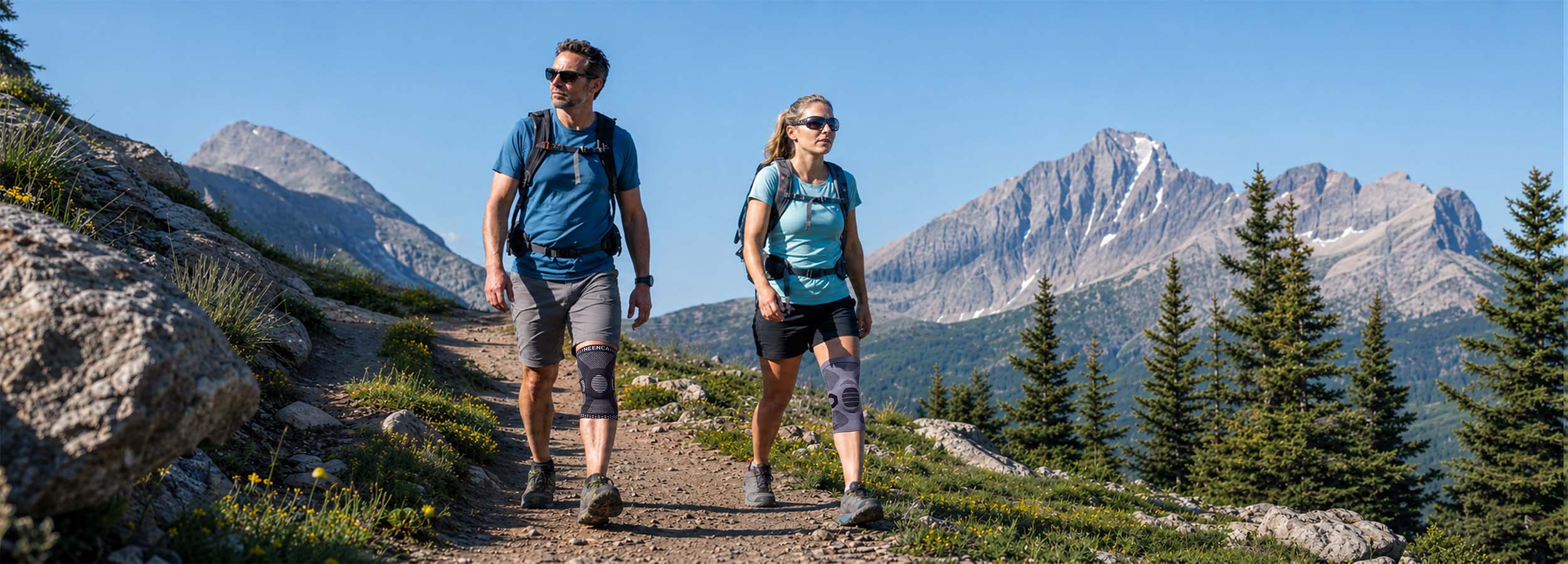
Knee Support for Hiking and Outdoor Activity
Hiking looks simple until the trail starts changing. A flat park path, a rocky descent, a muddy forest trail, and a weekend backpacking route all ask different things from your knees. The challenge is not only distance. It is the mix of uneven ground, downhill steps, changing pace, fatigue, weather, footwear, and sometimes the extra weight of a pack.
That is why knee support for hiking should be chosen differently from knee support for the gym or for standing at work. A brace that feels supportive indoors may slide when you sweat on a climb. A heavy brace may feel secure at the trailhead but uncomfortable after several miles. A light sleeve may be enough for casual trail walking, but not enough for someone who wants a more secure feel on hilly terrain.
This guide explains how to choose knee support for hiking and outdoor activity based on real trail conditions. The best choice is not automatically the strongest brace. The best choice is the support level you can wear comfortably, move naturally in, and trust through the kind of outdoor activity you actually do.
If you are unsure which support level fits your routine, start with the NEENCA Knee Brace Finder before comparing individual products.
This article is for general educational purposes only and is not a substitute for professional medical advice, diagnosis, or treatment. If you have sharp pain, swelling, instability, locking, numbness, a recent injury, post-surgery restrictions, or difficulty bearing weight, consult a qualified healthcare professional before using a brace to continue hiking or outdoor activity.
Why Hiking Can Be Tough on the Knees
Unlike walking on a flat sidewalk, hiking rarely gives your knees the same step twice. Trail surfaces can shift from gravel to dirt, stairs, roots, rocks, slopes, wet leaves, and uneven ground. Your knee has to help control direction, balance, descent, and repeated bending while the rest of your body adjusts to the terrain.
Several hiking conditions can make knee support more important:
- Downhill sections: Descending often requires more controlled braking from the legs, especially when steps are steep or uneven.
- Uneven terrain: Roots, rocks, loose gravel, and angled trails can make each step less predictable.
- Long mileage: Even moderate terrain can feel demanding when repeated for hours.
- Backpack weight: A daypack or overnight pack changes how the body manages load, balance, and fatigue.
- Weather and trail conditions: Wet, cold, muddy, or hot conditions can affect footing and comfort.
- Fatigue: As the hike goes on, form, balance, and step control can change.
Research on hiking and trail activity often points to the lower limb as an important area of concern for hikers. Long-distance hiking research also suggests that training habits and gear choices such as stabilizing footwear and poles may matter. That does not mean every hiker needs a brace, and it does not mean a brace can prevent hiking injuries. It does mean hikers should choose support with the trail in mind, not just the product photo.
What Knee Support Can and Cannot Do Outdoors
A knee sleeve or brace can help provide compression, a more secure feel, and added support around the knee during outdoor movement. For some hikers, that supported feeling can make long walks, hilly routes, or uneven terrain feel more manageable.
Direct research on consumer knee braces specifically for ordinary hiking is limited. The better way to read the evidence is to combine two related areas: hiking research, which helps explain terrain, downhill walking, gear, and fatigue; and knee sleeve or orthosis research, which helps explain compression, fit, proprioception, and brace-category limitations. That is why this guide discusses knee support as one part of a broader outdoor setup, not as a stand-alone solution.
However, knee support is only one part of outdoor readiness. It cannot replace proper footwear, smart route selection, gradual conditioning, trekking poles when appropriate, a realistic pace, pack management, hydration, or professional care when symptoms are present.
A practical way to think about hiking knee support is:
- It can help the knee feel more supported during repeated movement.
- It can provide compression and a closer fit around the joint.
- It can improve your sense of support on longer walks or variable terrain.
- It should not change your natural walking pattern in a negative way.
- It should not be used to push through sharp pain or worsening symptoms.
Knee Sleeve vs Knee Brace for Hiking
The right support depends on your trail, your body, and how much structure you want. Most hikers can begin by comparing three general support directions.
| Support Type | Best For | Why It May Work Outdoors | What to Watch |
|---|---|---|---|
| Light Supportive Compression | Casual walks, easy trails, travel days, low-profile support | Breathable, flexible, easy to wear under outdoor clothing | May feel too light for steeper routes or users who want more structure |
| Supportive Compression Brace | Day hikes, hilly trails, longer walks, active weekends | Can combine compression, patella-area support, side support, and anti-slip fit | Must still allow natural stride, climbing, and downhill control |
| Structured or Side-Specific Support | Walking and daily movement when a user wants more controlled support direction | More structure and adjustability than a sleeve-style option | Professional fitting guidance is recommended; not the default choice for casual hiking |
For many hikers, a lightweight sleeve or supportive compression brace is the most practical place to start. A more structured brace may be considered when a user wants a higher level of support, but it should be chosen carefully and fitted properly.
Choose Support Based on the Trail, Not Just the Knee
Easy Park Walks and Light Trails
For flat trails, paved park paths, travel walking, and short outdoor routines, many users prefer low-profile support that feels comfortable and breathable. A brace should not feel heavy or restrictive for this type of activity.
In this setting, comfort matters as much as structure. If the support is too warm, too tight, or too bulky, you may not wear it consistently.
Moderate Day Hikes
Day hikes often include longer mileage, mild elevation changes, stairs, rocks, or uneven ground. This is where secure fit becomes more important. A sleeve or brace that slowly slides down can become distracting and uncomfortable.
Look for compression that feels supportive without squeezing, anti-slip construction, and enough flexibility to climb steps or move around obstacles.
Steep Downhill Routes
Downhill hiking is where many people start noticing their knees more. The body has to control each step instead of simply moving forward. A supportive brace may help some hikers feel more secure, but it should be paired with smart pacing and controlled steps.
Trekking poles may also be useful for some hikers because downhill-walking research has found lower knee-joint forces and moments when poles were used. A brace is not the only tool in the system.
Backpacking and Loaded Hikes
Backpacking adds another variable: load. A heavier pack can change balance, fatigue, stride, and how the body handles downhill sections. Before increasing distance or pack weight, test your knee support on shorter routes first.
If your knee support feels good during a short walk but starts slipping or pinching after sweating under a pack, it may not be the right product or size for loaded hiking.
Outdoor Work and Active Weekends
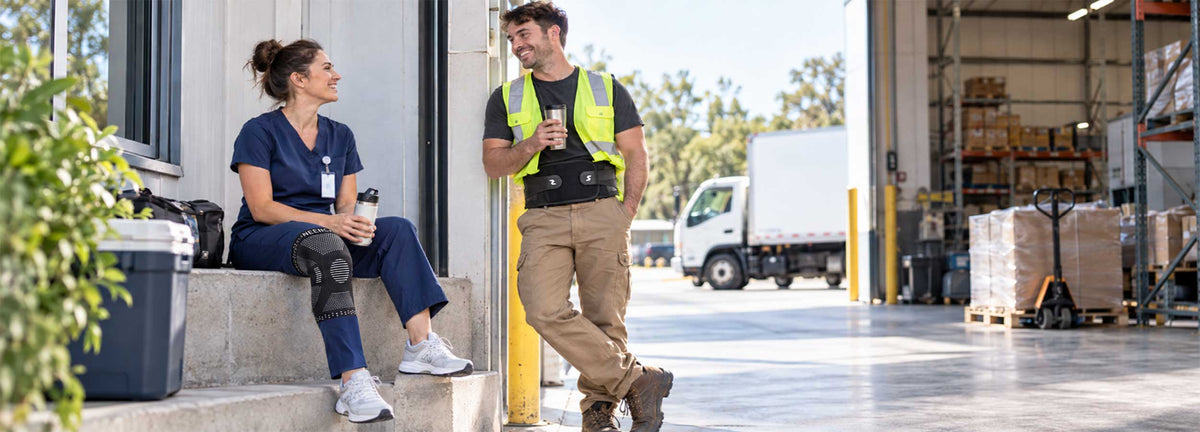
Some people need knee support not only for hiking, but also for yard work, camping, walking the dog, travel days, weekend sports, or outdoor jobs. In that case, choose a brace that balances support with all-day wearability.
Features That Matter in a Hiking Knee Brace
1. Secure Fit That Does Not Slide
Hiking often includes sweat, incline, downhill steps, and repeated bending. A brace that slides during the first mile will not become more comfortable later.
Look for a design that stays centered around the kneecap area and does not twist as you climb, descend, or step over uneven ground.
2. Patella Support and Side Stabilizers
If you want more than basic compression, consider a design with a contoured patella gel pad and flexible side stabilizers. Patella-area support can help the brace sit more naturally around the kneecap, while side stabilizers can provide a more structured support feel without turning the brace into a rigid device.
The goal is not to lock the knee. The goal is to support outdoor movement while still allowing you to walk, climb, and descend comfortably.
3. Breathable Materials
Outdoor activity can involve heat, humidity, sun, cold starts, and changing layers. A knee brace that traps too much heat can become uncomfortable on longer hikes.
Breathable knit materials, soft edges, and moisture-conscious design are especially important for warm-weather hiking and longer trail days.
4. Flexible Movement
A hiking knee support product should allow natural walking, step-ups, crouching, climbing, and descending. If the brace makes your stride feel forced or changes the way you place your foot, it may not be right for that route.
5. Compatibility With Outdoor Clothing
Some hikers wear knee support under hiking pants, while others wear it with shorts or over a thin base layer. The brace should not bunch under clothing or rub against seams during long walks.
6. Easy Fit Check Before the Trail
Outdoor conditions are harder to control than the gym. Check the fit before leaving home, after warming up, and again after the first part of the trail. Small fit issues can become bigger after mileage, sweat, and downhill sections.
Which ACE Model Is Right for Hiking?
ACE-50, ACE-51, and ACE-53 all include a contoured patella gel pad, flexible side stabilizers, and compression support. The main differences are wearing feel, material comfort, breathability, compression feel, and price.
| Model | Feel | Best For Hiking and Outdoor Activity |
|---|---|---|
| ACE-50 | Lightest, softest, and most breathable | Users who want the most comfortable and breathable ACE option for daily wear, light trail walks, travel walking, and easy outdoor activity |
| ACE-51 | Thicker, more secure compression with a more comfortable material feel | Users who want a stronger wrap feel while still prioritizing comfort and material quality for longer walks, hilly trails, and active weekends |
| ACE-53 | Thicker, firmer compression with better value | Users who want a similar thicker compression feel to ACE-51 at a slightly lower price for regular outdoor walking and hiking routines |
Choose NEENCA ACE-50 Professional Knee Brace if your priority is the lightest, softest, and most breathable ACE option for easy trails and daily outdoor movement.
Choose NEENCA ACE-51 Professional Knee Brace if you want thicker, more secure compression with a more comfortable material feel for longer walks, hilly terrain, and active weekends.
Choose NEENCA ACE-53 Professional Knee Support if you want a similar thicker, firmer compression feel to ACE-51 at a slightly lower price.
For users who want highly structured, side-specific support during walking and daily movement, the NEENCA OA Unloader Knee Brace 052 is a more specialized option to compare. Because this style affects how support feels around the knee, professional fitting guidance is recommended.
Fit: The Detail That Makes or Breaks Trail Comfort
Fit matters more outdoors because the brace has to perform after movement, sweat, terrain changes, and repeated steps.
A hiking knee support product should:
- Stay centered around the kneecap area
- Feel snug but not restrictive
- Allow full comfortable walking motion
- Not bunch behind the knee during climbing or descending
- Not slide down after you start sweating
- Not cause numbness, tingling, coldness, discoloration, or unusual pressure marks
Before choosing a product, use the NEENCA Find Your Size guide and follow the product-specific measurement instructions. Do not choose a brace only by height, weight, or usual clothing size.
Test Your Knee Support Before a Real Hike
Do not test a new brace for the first time on a long trail. Try it during easier movement first so you can check fit and comfort before the conditions become harder to manage.
A practical test can include:
- A short neighborhood walk
- Stairs or a mild hill
- A light pack if you plan to carry one
- A few step-ups or controlled uphill movements
- A fit check after warming up
- A second fit check after sweating
If the brace slips, pinches, twists, or changes your walking pattern, adjust the fit or choose a different support level before taking it onto the trail.
Do Not Rely on a Brace Alone
Good outdoor support is a system. A knee brace can help, but it works best when paired with the rest of your hiking setup.
Footwear
Choose shoes or boots that match the terrain. Worn-out soles, poor fit, or unstable footwear can affect how your feet, ankles, knees, hips, and back handle the trail.
Trekking Poles
For downhill hiking or loaded routes, trekking poles may help some hikers manage load and balance. They are especially useful when the trail is steep, loose, wet, or uneven.
Pack Weight
Carry what you need, but avoid unnecessary weight. Pack placement, total load, and fatigue can all affect how your body moves on the trail.
Pacing
Outdoor activity should match your current conditioning. Increase distance, elevation, speed, and pack weight gradually rather than changing everything at once.
Trail Planning
Check distance, terrain, weather, daylight, water access, and route difficulty before you go. The National Park Service recommends choosing trails that match your ability and planning ahead for the conditions you may encounter.
When to Stop Hiking and Get Help
Knee support should never be used to force yourself through warning signs. Stop activity and seek guidance if you notice:
- Sharp knee pain
- Sudden swelling
- A knee that gives way
- Locking or catching
- Numbness or tingling
- Pain after a twist, fall, or direct impact
- Difficulty bearing weight
- Symptoms that worsen as you continue
On remote trails, small problems can become harder to manage because help may be farther away. Plan conservatively, tell someone where you are going, and carry the gear your route requires.
How to Choose the Right NEENCA Knee Support for Outdoor Activity
Start with your most common outdoor scenario:
| Outdoor Situation | Support Direction | NEENCA Option to Compare |
|---|---|---|
| Easy trails, travel walking, casual outdoor activity | Lightest and most breathable ACE support | ACE-50 |
| Longer walks, hilly trails, active weekends | Thicker, more secure compression with comfort-focused material feel | ACE-51 |
| Regular outdoor walking with value-focused support | Thicker, firmer compression at a slightly lower price | ACE-53 |
| Highly structured, side-specific walking support | Specialized support with professional fitting guidance recommended | OA Unloader Knee Brace 052 |
To compare more options, browse the NEENCA Knee Braces Collection and choose based on your trail type, fit needs, and preferred support level.
Final Thoughts
Knee support for hiking and outdoor activity should help you move with more confidence without making the trail feel less natural. The right brace should stay in place, breathe well, support the kneecap area, allow normal stride, and match the terrain you plan to cover.
For easy outdoor walks, ACE-50 may be the better starting point. For longer or hillier routes, ACE-51 may provide a more secure compression feel. For regular hikers who want a similar firmer feel at a slightly lower price, ACE-53 is worth comparing. For users who want highly structured, side-specific walking support, OA 052 requires more careful fitting and guidance.
The best outdoor support plan is never only about the brace. Footwear, trekking poles, pack weight, trail planning, pacing, conditioning, and early attention to warning signs all matter.
Frequently Asked Questions
Should I wear a knee brace while hiking?
Some hikers use knee support for compression, comfort, and a more secure feel on longer or uneven routes. Whether it makes sense depends on your trail, fit, support preference, and whether you can walk naturally while wearing it.
Is a knee sleeve enough for hiking?
A lighter supportive compression option may be enough for easy trails, travel walking, and casual outdoor activity. If you hike longer distances, carry a pack, or want a stronger wrap feel, a more supportive brace may be worth comparing.
What knee support is best for downhill hiking?
Downhill hiking often feels more demanding because each step requires control. A supportive compression brace, good footwear, careful pacing, and trekking poles may all be part of a better downhill strategy. Stop if pain becomes sharp, unstable, or worsening.
Can I wear a knee brace under hiking pants?
Yes, if the brace fits comfortably and does not bunch, rub, or restrict movement. Test it with your actual hiking pants before a longer trail day.
Should I choose ACE-50, ACE-51, or ACE-53 for hiking?
Choose ACE-50 if you want the lightest, softest, and most breathable ACE option. Choose ACE-51 if you want thicker, more secure compression with a more comfortable material feel. Choose ACE-53 if you want a similar thicker, firmer compression feel to ACE-51 at a slightly lower price.
When should I avoid hiking with knee discomfort?
Avoid continuing if you have sharp pain, swelling, instability, locking, numbness, tingling, difficulty bearing weight, or symptoms after a fall, twist, or direct impact. Get qualified guidance before returning to the trail.
References
- Braybrook PJ, Tohira H, Birnie T, Brink D, Finn J, Buzzacott P. Types and Anatomical Locations of Injuries Among Mountain Bikers and Hikers: A Systematic Review. PLoS One. 2023.
https://pmc.ncbi.nlm.nih.gov/articles/PMC10468092/ - Chrusch A, Kavin M. Survey of Musculoskeletal Injuries, Prehike Conditioning, and On-Trail Injury Prevention Strategies Self-Reported by Long-Distance Hikers on the Appalachian Trail. Wilderness & Environmental Medicine. 2021.
https://pubmed.ncbi.nlm.nih.gov/34301477/ - Ramlee MH, Abdul Aziz NA, Abu Osman NA, Wan Abas WAB. Biomechanical and Functional Efficacy of Knee Sleeves: A Literature Review. Physical Therapy in Sport. 2017.
https://pubmed.ncbi.nlm.nih.gov/28673759/ - Ghai S, et al. Influence of Compression Garments on Proprioception: A Systematic Review and Meta-Analysis. Annals of the New York Academy of Sciences. 2024.
https://pubmed.ncbi.nlm.nih.gov/38722733/ - Dzidotor GK, Moorhead JB Jr, Ude CC, Ogueri KS, Ghosh D, Laurencin CT. Functions and Effectiveness of Unloader, Patellofemoral, and Knee Sleeve Orthoses: A Review. Regenerative Engineering and Translational Medicine. 2023.
https://pmc.ncbi.nlm.nih.gov/articles/PMC11233114/ - Schwameder H, Roithner R, Müller E, Niessen W, Raschner C. Knee Joint Forces During Downhill Walking With Hiking Poles. Journal of Sports Sciences. 1999.
https://pubmed.ncbi.nlm.nih.gov/10622357/ - National Park Service. Hike Smart. U.S. National Park Service.
https://www.nps.gov/articles/hiking-safety.htm



Оставить комментарий
Этот веб-сайт защищается hCaptcha. Применяются Политика конфиденциальности и Условия использования hCaptcha.