




Hinged Knee Brace vs Compression Sleeve
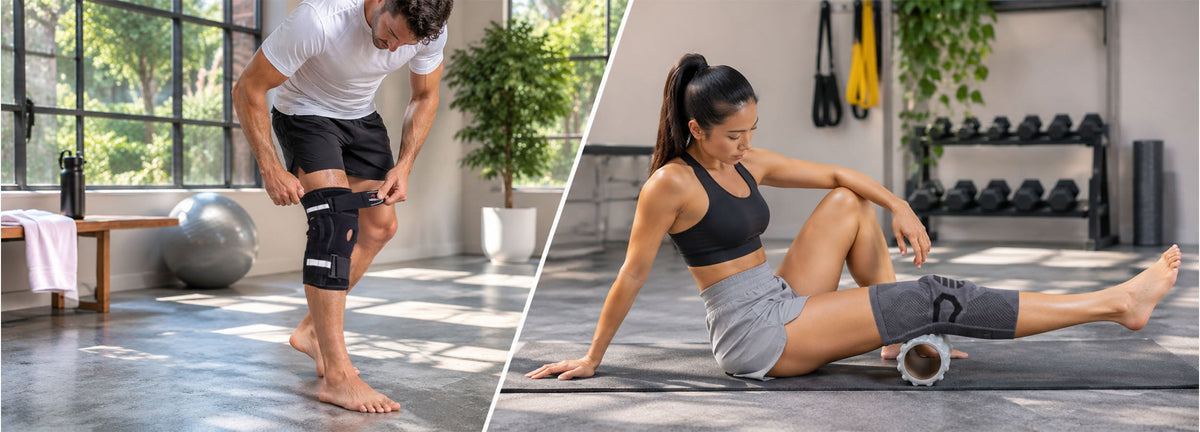
Hinged knee braces and compression sleeves are both used for knee support, but they are built around different support strategies. A compression sleeve relies mainly on flexible material, close contact, and compression. A hinged brace adds mechanical side structure through hinges, usually combined with straps or wraparound panels.
That does not mean a hinged brace is automatically the better option. The more useful question is: how much structure do you actually need for the way you plan to move?
For clarity, this guide uses compression sleeve to mean a flexible, non-hinged knee support whose main function comes from elastic compression. Some products add gel pads or flexible side stabilizers and are better described as supportive compression braces rather than basic sleeves. That distinction matters when comparing real products.
Quick Answer: Hinged Knee Brace vs Compression Sleeve
| Your Priority | Start With | Why |
|---|---|---|
| Flexible, lower-profile support | Compression sleeve | Elastic construction moves easily with the knee and usually adds less bulk |
| More mechanical side structure | Hinged knee brace | Rigid or semi-rigid hinges add structure along the sides of the knee |
| Simple pull-on wear | Compression sleeve | There are usually fewer straps or components to adjust |
| More fit adjustment | Hinged knee brace | Straps can change how firmly the brace wraps the thigh and calf |
| Long daily wear with less hardware | Often compression sleeve | Lower bulk can be easier to tolerate for extended use |
| A deliberately firmer, more structured feel | Hinged knee brace | The hinge-and-strap system creates a more mechanically structured fit |
The decision is not “light support versus maximum support.” It is a tradeoff between flexibility, mechanical structure, adjustability, comfort, and activity demands.
What Is a Compression Knee Sleeve?
A compression sleeve is a pull-on support made primarily from elastic or knitted material. Its main support comes from the way the material fits closely around the knee.
Basic sleeves may be simple, while more developed flexible supports can add features such as:
- reinforced knit zones;
- anti-slip bands;
- patella cushioning;
- flexible side stabilizers.
A 2024 review of knee orthoses shows why the terminology can become confusing: sleeve-based designs can be modified with patellar components, straps, buttresses, or additional support features.1
So a product can use compression-knit construction without being a basic compression sleeve.
For the broader taxonomy of sleeves and braces, see Knee Sleeve vs Knee Brace: What’s the Difference?. That article owns the general sleeve-vs-brace classification; this guide focuses specifically on flexible compression versus hinged structure.
What Is a Hinged Knee Brace?
A hinged knee brace adds a mechanical component along one or both sides of the knee. Depending on the design, the hinges may be rigid or semi-rigid and may be removable or integrated into the brace.
Hinges are commonly paired with straps or wraparound panels that help secure the brace around the thigh and calf.
A 2025 review in Sports Engineering emphasizes that brace performance depends on more than the presence of a hinge. Materials, frame stiffness, padding, straps, fit, anatomy, and hinge design all influence how a brace behaves and feels.2
A separate 2025 engineering study found that hinge mechanism affected brace migration during walking, while strap tension affected the measured brace abduction moment.3 That study examined a specific brace setup and should not be generalized to every hinged knee brace, but it illustrates an important principle: fit and adjustment are part of how a hinged brace functions.
The Main Difference: Flexible Compression vs Mechanical Side Structure
A compression sleeve mainly provides support through:
- elastic compression;
- close contact with the leg;
- material stiffness;
- reinforced knit zones when included.
A supportive compression brace may add cushioning or flexible stabilizers, but the support system is still predominantly flexible.
A hinged brace adds:
- rigid or semi-rigid side components;
- mechanical hinges that move as the knee bends;
- adjustable straps or wraparound closures;
- a more structured fit around the sides of the knee.
The 2025 sports-engineering review describes flexible sleeve-type products as generally less stiff than mechanically structured braces. Additional stiffness can provide more structure, but it also adds hardware, weight, and fit considerations.2
Does a Hinged Brace Provide More Support?
It provides more mechanical structure. That is more precise than saying it is always more supportive.
If your definition of support is firmer side structure and adjustable restraint, a hinged brace generally offers more than a flexible sleeve. If your goal is close compression during walking, work, workouts, or everyday movement, a flexible support may better match what you want.
A 2025 systematic review of nonoperative knee bracing found that outcomes varied by condition and brace type. The review supports matching brace design to the individual situation rather than treating one brace category as universally superior.4
More hardware is useful only when you actually need what that hardware adds.
What Can Compression Add Without Hinges?
Compression sleeves are popular because they are flexible, easy to wear, and close fitting. Research suggests that compression can influence joint-position feedback, although the effect is not consistent across all measurements.
A 2024 systematic review and meta-analysis of 27 compression-garment studies found improvement in one measure of joint-position accuracy, while several other proprioceptive outcomes were not significantly changed.5
This evidence should not be turned into a claim that a sleeve “stabilizes the knee” or prevents injury. It simply shows that flexible compression can affect how joint position is perceived without using a rigid mechanical hinge.
When a Compression Sleeve Usually Makes More Sense
You want less bulk
A flexible pull-on sleeve is usually easier to wear under pants and has fewer external components than a hinged wraparound brace.
You want straightforward daily wear
For walking, commuting, work, travel, or errands, fewer straps and rigid parts may make a sleeve easier to integrate into a normal routine.
You prioritize flexible movement
A sleeve moves with the knee instead of adding mechanical side hinges. That can be useful when you do not want a strongly structured wearing feel.
You do not need significant side structure
If your goal is primarily compression and a close fit, a hinge may add complexity without solving a problem you actually have.
When a Hinged Knee Brace Usually Makes More Sense
You intentionally want firmer side structure
Hinges add a mechanical element along the sides of the knee that a basic flexible sleeve does not provide.
You want more adjustment
Many hinged designs use separate straps around the upper and lower leg, giving you more control over the wrap than fixed sleeve compression.
You prefer a more noticeable, structured fit
Some users prefer the secure feel of a brace that is mechanically anchored around the knee, even when that means accepting more bulk.
You have been advised to use a hinged style
If a clinician has recommended a particular hinged brace for an injury or rehabilitation stage, that recommendation takes priority over a general consumer comparison.
Hinged Brace vs Compression Sleeve: Practical Comparison
| Feature | Compression Sleeve | Hinged Knee Brace |
|---|---|---|
| Main support method | Flexible compression | Mechanical hinges plus brace body and straps |
| Side structure | Minimal; some enhanced designs add flexible stabilizers | Rigid or semi-rigid side hinges |
| Fit adjustment | Mainly controlled by sizing and stretch | Usually more adjustable through straps and closures |
| Bulk | Usually lower | Usually higher |
| Under clothing | Usually easier | More noticeable |
| Movement feel | Flexible and close fitting | Firmer and more structured |
| Best reason to choose it | You want flexible compression with less hardware | You deliberately want more mechanical side structure and adjustment |
Where NEENCA Products Fit in This Comparison
One important distinction is that not every NEENCA compression-knit product should be classified as a basic compression sleeve.
The NEENCA ACE-50, for example, uses compression-knit construction but also includes targeted patella cushioning and flexible side stabilizers. It is therefore more accurate to think of it as a supportive compression brace that sits between a basic flexible sleeve and a mechanically hinged brace.
ACE-50 is the lighter, softer, and more breathable option within its ACE support group, making it relevant when flexible support and everyday comfort matter more than mechanical hinges.
ACE-51 follows a similar supportive-compression concept but uses a thicker, firmer compression feel. Its side stabilizers are flexible TPEE components rather than metal hinges.
The NEENCA HX042/HX035 belongs on the hinged side of the comparison. It uses removable side hinges and front-crossing X-straps, creating more mechanical side structure and fit adjustment than the ACE compression braces.
| NEENCA Option | Support Construction | Consider It If... |
|---|---|---|
| ACE-50 | Supportive compression brace with patella cushioning and flexible side stabilizers | You want lighter, softer, more breathable flexible support without mechanical hinges |
| ACE-51 | Supportive compression brace with firmer compression and flexible side stabilizers | You prefer a thicker, more secure compression feel while keeping a flexible design |
| HX042/HX035 | Brace with removable side hinges and front-crossing X-straps | You intentionally want more mechanical side structure and adjustable wrapping |
These products are not a “good, better, best” ladder. They occupy different points on a spectrum from flexible compression to mechanical structure.
If you are comparing support levels rather than following a medical brace prescription, the NEENCA Knee Brace Finder can help narrow your options.
What About Daily Activity, Work, and Exercise?
The right tradeoff changes with the activity.
For a long workday, bulk, breathability, edge comfort, and ease of movement may matter more than maximum structure. During gym training or recreational sport, secure positioning through repeated bending and sweating may become more important. For general walking, a brace that stays centered and feels comfortable may matter more than either category label.
There is no evidence-based rule that every athlete needs a hinged brace or that every everyday user should choose a sleeve. Recent reviews consistently show that design, fit, activity, and the population being studied all matter.2, 4
Fit Problems Differ Between the Two Designs
Compression sleeves and hinged braces tend to fail in different ways.
With a sleeve, watch for rolling, sliding, bunching behind the knee, excessive compression, or heat buildup. With a hinged brace, pay extra attention to hinge position, uneven strap tension, brace migration, and pressure from the hinge or strap edges.
The 2025 hinge study is relevant here because it directly showed that hinge mechanism and strap tension can change how a structured brace behaves during walking.3
For detailed sizing and tightness guidance, use How Tight Should a Knee Brace Be?. This article does not need to repeat that page’s full fit guidance.
Does Open vs Closed Patella Decide This Choice?
No. “Hinged vs compression” and “open vs closed patella” describe different design dimensions.
Many hinged braces use an open-patella front, but the added mechanical structure comes from the hinges and straps. Compression-based supports can use continuous front coverage or a patella opening depending on the design.
If kneecap coverage is your main decision, see Open Patella vs Closed Patella Knee Brace. That page owns the patella-design comparison; this article owns the mechanical-structure comparison.
When This Comparison Is Not Enough
A general hinged-vs-compression guide should not replace professional guidance if you have a recent significant injury, repeated giving-way, locking, rapidly increasing swelling, difficulty bearing weight, recent surgery, or a prescribed postoperative or range-of-motion brace.
In those situations, the brace may be part of a specific rehabilitation plan rather than a general support preference.
Frequently Asked Questions
Is a hinged knee brace stronger than a compression sleeve?
A hinged brace generally provides more mechanical side structure. That does not automatically make it the better choice. A flexible compression support may be more appropriate when your priorities are lower bulk, flexible movement, and everyday comfort.
Can a compression brace provide side support without hinges?
Yes. Some supportive compression braces use flexible side stabilizers. They add more structure than a basic sleeve but do not provide the same mechanical support as rigid or semi-rigid hinges.
Should I choose a hinged brace just because my knee feels unstable?
Not automatically. New or significant instability can have several causes and may need professional assessment. A more structured brace can provide external support, but it does not identify or correct the underlying cause.
Final Takeaway
The useful distinction between a hinged knee brace and a compression sleeve is mechanical side structure versus flexible compression.
A basic compression sleeve is usually lower profile and easier to integrate into everyday movement. Supportive compression braces can add patella cushioning and flexible side stabilizers while remaining non-hinged. A hinged brace adds firmer side structure and adjustable straps, but also adds bulk and requires more careful positioning.
Current evidence does not support a universal hierarchy in which one design is always better. Brace construction, fit, hinge mechanics, strap tension, activity demands, and individual preference all matter.2, 4
Medical disclaimer: This article is for general educational purposes only and is not a substitute for medical advice, diagnosis, or treatment. Consult a qualified healthcare professional for a recent injury, significant instability, locking, major swelling, difficulty bearing weight, post-surgical needs, or questions about a prescribed brace.
References
- Dzidotor GK, Moorhead JB Jr, Ude CC, Ogueri KS, Ghosh D, Laurencin CT. Functions and Effectiveness of Unloader, Patellofemoral, and Knee Sleeve Orthoses: A Review. Regenerative Engineering and Translational Medicine. 2024;10(2):147-171.
- Sabir T, Allen T, Callaghan MJ, Hodson-Tole E. Ten questions in sports engineering: knee brace efficacy for sports injuries. Sports Engineering. 2025;28:41.
- Yan Y, Li T, Li H, Han B, Liu G. The effect of hinge mechanism and strap tension of knee brace on brace migration and brace abduction moment. Journal of Mechanical Science and Technology. 2025;39:4845-4852.
- Bouchard MD, Gilbert J, Cruickshank M, et al. The effectiveness of knee bracing in non-operative soft tissue and degenerative knee injuries: A systematic review. Knee Surgery, Sports Traumatology, Arthroscopy. 2025;33(12):4446-4465.
- Ghai S, Nilson F, Gustavsson J, Ghai I. Influence of compression garments on proprioception: A systematic review and meta-analysis. Annals of the New York Academy of Sciences. 2024;1536(1):60-81.




اترك تعليقًا
This site is protected by hCaptcha and the hCaptcha Privacy Policy and Terms of Service apply.