


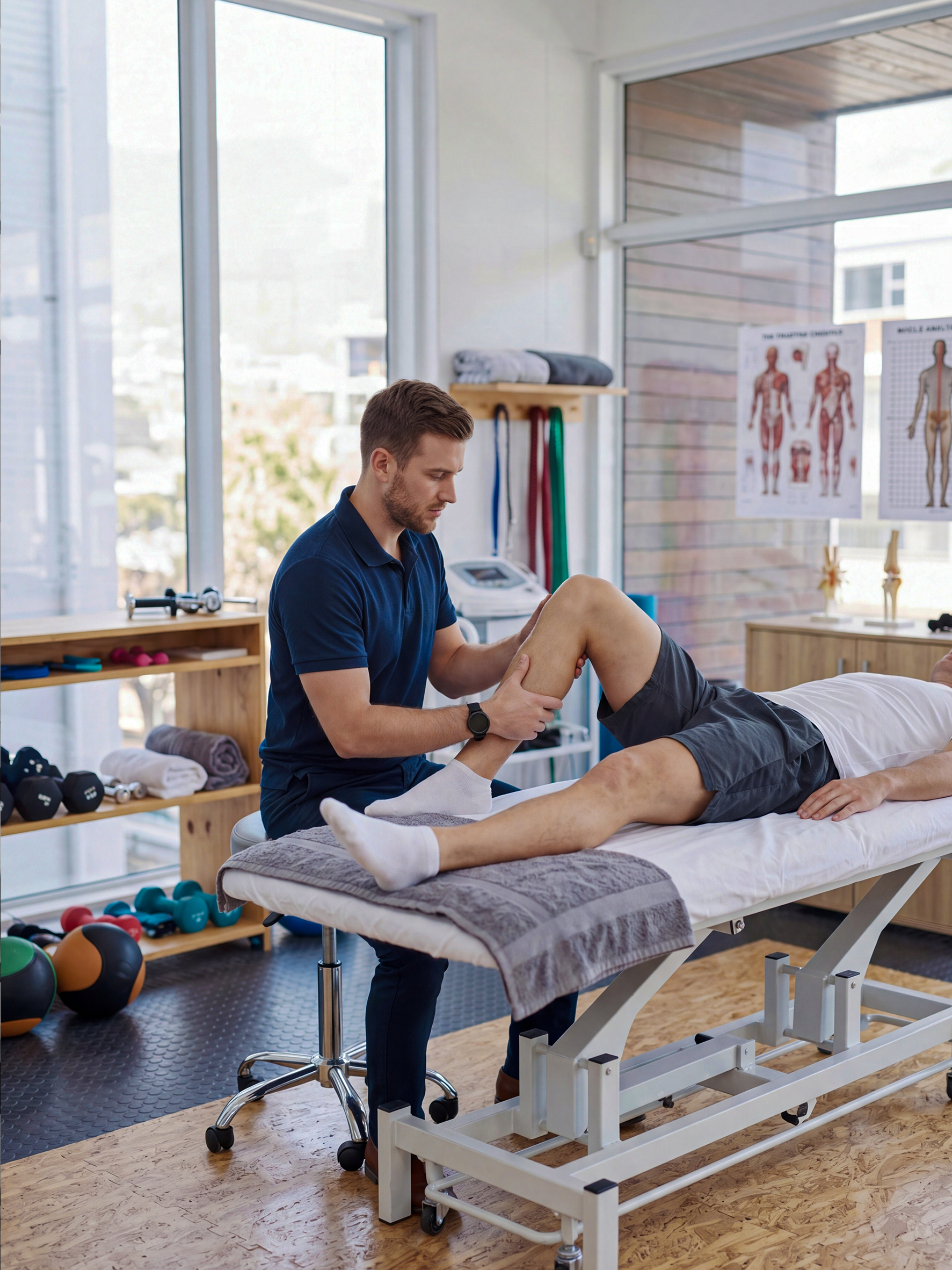


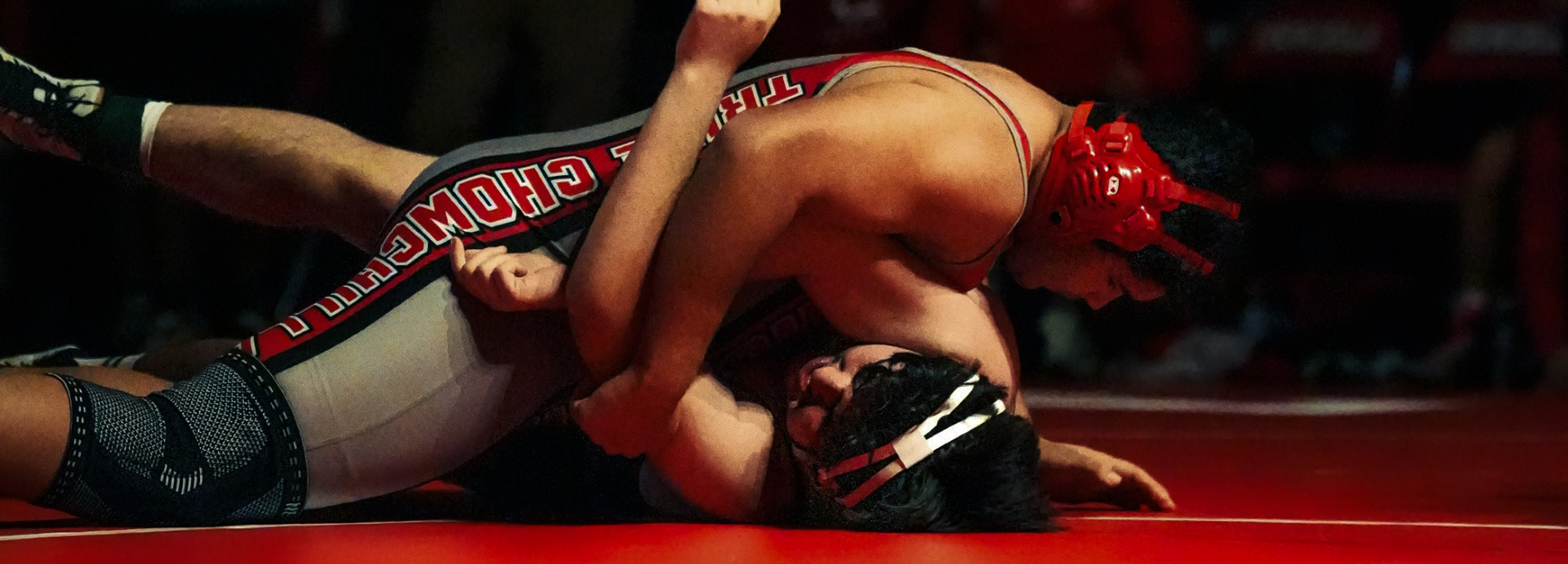
Wrestling Knee Recovery Guide for Wrestlers and Parents

This article is for general educational purposes only and is not a substitute for professional medical advice, diagnosis, or treatment. Wrestlers with swelling, instability, locking, significant pain, or limited movement should consult a qualified healthcare professional, athletic trainer, or physical therapist.
It's 9 PM. Practice ran late. Your son throws his gear bag by the door, grabs ice from the freezer without saying a word, and plants himself on the couch.
You've seen this before. The knees. Always the knees.
If you're the parent of a high school wrestler — or a wrestler yourself — you already know the drill. Soreness after a hard practice is just part of the sport. But there's a difference between the kind of fatigue you sleep off and the kind that compounds, week after week, until one morning your athlete can barely get out of bed without wincing.
This guide is about that difference. Not about dramatic injuries. About the day-to-day wear on the knee joint that most wrestlers and their parents treat as normal — and what you can actually do about it in the 24 hours after a tough practice.
Section 1 — Why Wrestling Is So Tough on the Knees
Wrestling is a contact sport built almost entirely around the lower body. Every takedown starts with a shot — a hard, explosive drop to one knee. Every scramble involves twisting, pivoting, and driving through the hips and knees at odd angles, often with an opponent's full body weight pressing down. Sprawls require a sudden backward hip drive that loads the patella against the mat. In a two-hour practice, a wrestler might execute hundreds of these movements against a resisting opponent, on a mat that doesn't give much. That adds up.
| Stat | Figure | Source |
|---|---|---|
| NCAA D-I wrestling injuries involving the knee | ~25% | NCAA Injury Surveillance System |
| High school wrestling injuries affecting the knee | 15% | Journal of Athletic Training |
| Injured wrestlers who sustain a recurrent knee injury | 1 in 5 | Iowa Orthopaedic Journal, 2023 |
A 2023 study in The Iowa Orthopaedic Journal tracked knee injuries in NCAA Division I wrestlers over a decade. Of 173 wrestling-related knee injuries, more than half were ligamentous — MCL and ACL sprains — and roughly 22% of injured wrestlers went on to suffer a recurrent knee injury, with return-to-sport time more than doubling after the second injury.
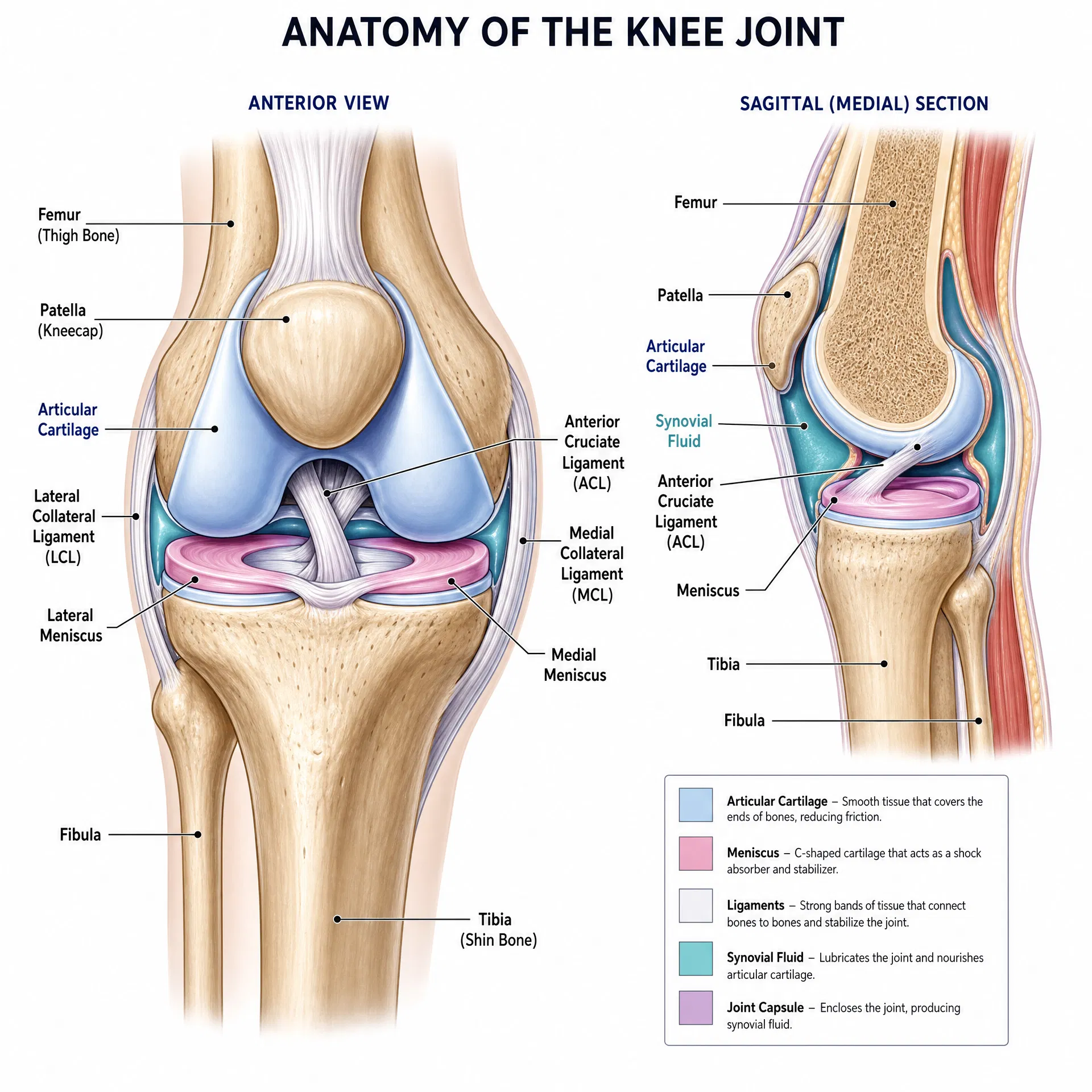
Wrestling Moves & Knee Stress
| Move | Primary stress point | Load level |
|---|---|---|
| Shot (single/double leg) | Patellar tendon, kneecap | High |
| Sprawl | Kneecap compression, quad | High |
| Scramble / stand-up | ACL / MCL rotational stress | High |
| Mat work (top/bottom) | Direct patellar pressure | Medium |
| Stance & movement | Quadriceps load, IT band | Moderate |
Knee Injury Types in NCAA Division I Wrestlers (n = 173)
| Injury type | Share |
|---|---|
| Ligamentous (MCL, ACL) | 53% |
| Meniscus | 22% |
| Patellar | 10% |
| Other | 14% |
Source: Tropp et al., The Iowa Orthopaedic Journal (2023)
One in five wrestlers who hurt their knee, hurts it again. The second time around, the road back is twice as long. Most of those recurrences don't happen because the first injury was severe. They happen because the recovery wasn't taken seriously.
The compounding problem: None of these stressors is catastrophic on its own. But a two-hour practice involves hundreds of repetitions of each. Over a 14-week season, that's a significant cumulative load on the same joint. How the knee is treated in the hours after practice determines whether that load stays manageable — or slowly builds into something that sidelines an athlete.
Section 2 — What Knee Fatigue Actually Feels Like
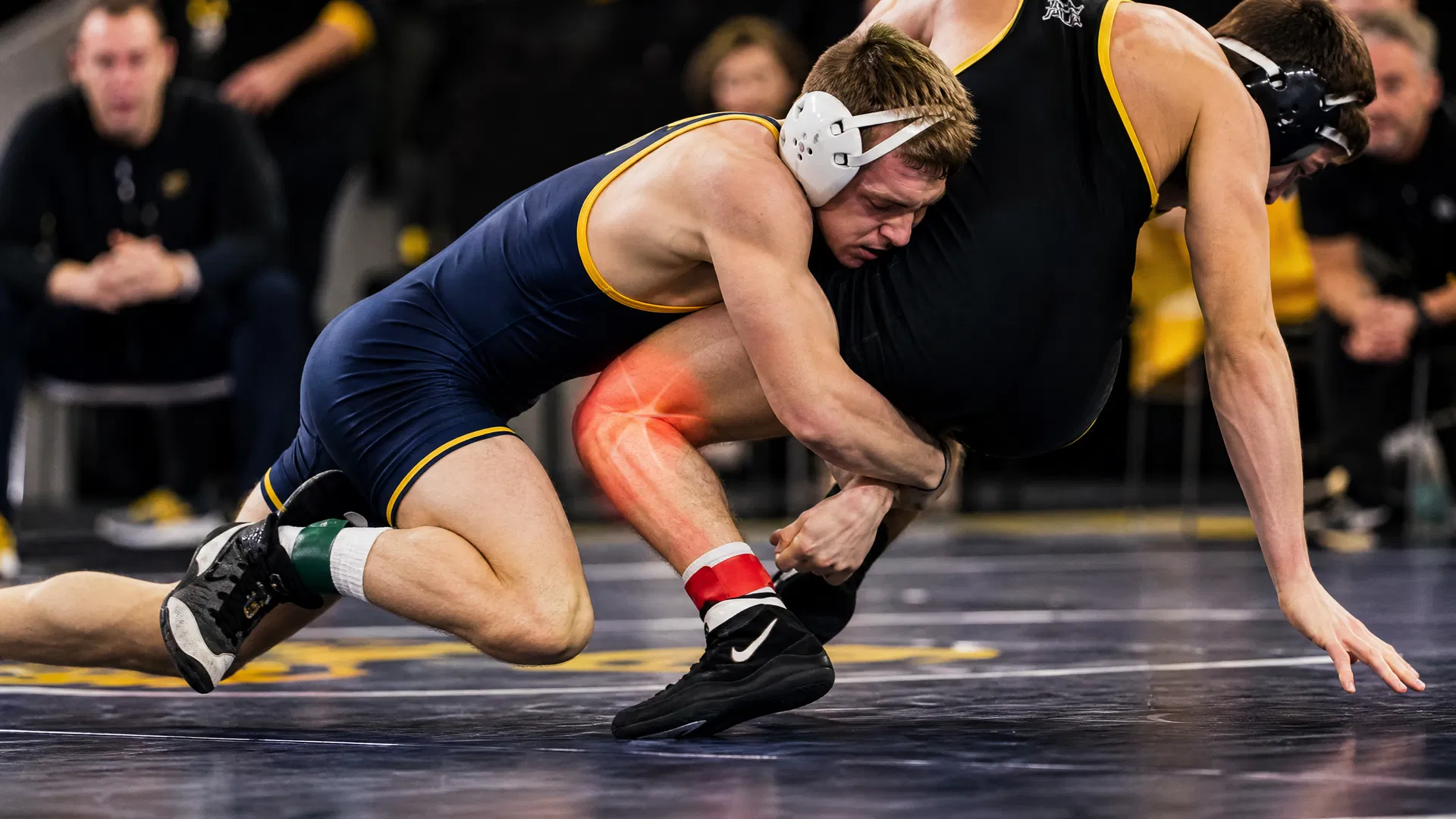
The repetitive stress of wrestling movements puts constant load on the knee joint
Real knee fatigue in wrestlers doesn't always feel like "pain." Not at first. What wrestlers describe — and what parents notice — tends to be subtler:
- Knees that feel heavy after practice — like the legs are just done
- Stiffness the next morning, especially the first 10 steps out of bed
- Soreness during warmups that goes away once moving — until it doesn't
- Shots that don't fire the same way — a slight hesitation before dropping to a knee
- Aching during car rides home, when the knee stays flexed for a while
- One knee that always "goes first" — usually the dominant shooting leg
If your athlete has stopped complaining about their knees, that's not necessarily a good sign. It might mean they've started treating chronic soreness as the new normal.
| Signal | What it usually means | Action |
|---|---|---|
| Soreness clears in 24–48 hours | Normal training fatigue | Monitor |
| Soreness persists 2–3 days | Joint stress accumulating | Adjust recovery |
| Visible swelling overnight | Inflammation beyond normal fatigue | Rest + ice |
| Sharp pain on inside/outside of joint | Possible ligament stress | See a doctor |
| Locking or catching sensation | Possible meniscus involvement | See a doctor immediately |
| Pain worsens over successive weeks | Cumulative — not resolving on its own | See a doctor |
Section 3 — What Wrestlers Should Do In The First 24 Hours After Practice
This is where recovery actually happens. Not in some off-season conditioning program. Right here, tonight, after practice ends.
- Walk 10–15 minutes — Keep circulation going. Don't shut down cold.
- Protein + carbs within 60 minutes — Supports post-practice nutrition and normal tissue maintenance.
- Rehydrate fully — Hydration supports normal joint function and overall training readiness.
- 10–15 min mobility work — Quad, hip flexor, IT band.
- Ice if swollen — 20 min, elevated — Only when swelling is present.
- 8–10 hours of sleep — A key time for normal recovery processes.
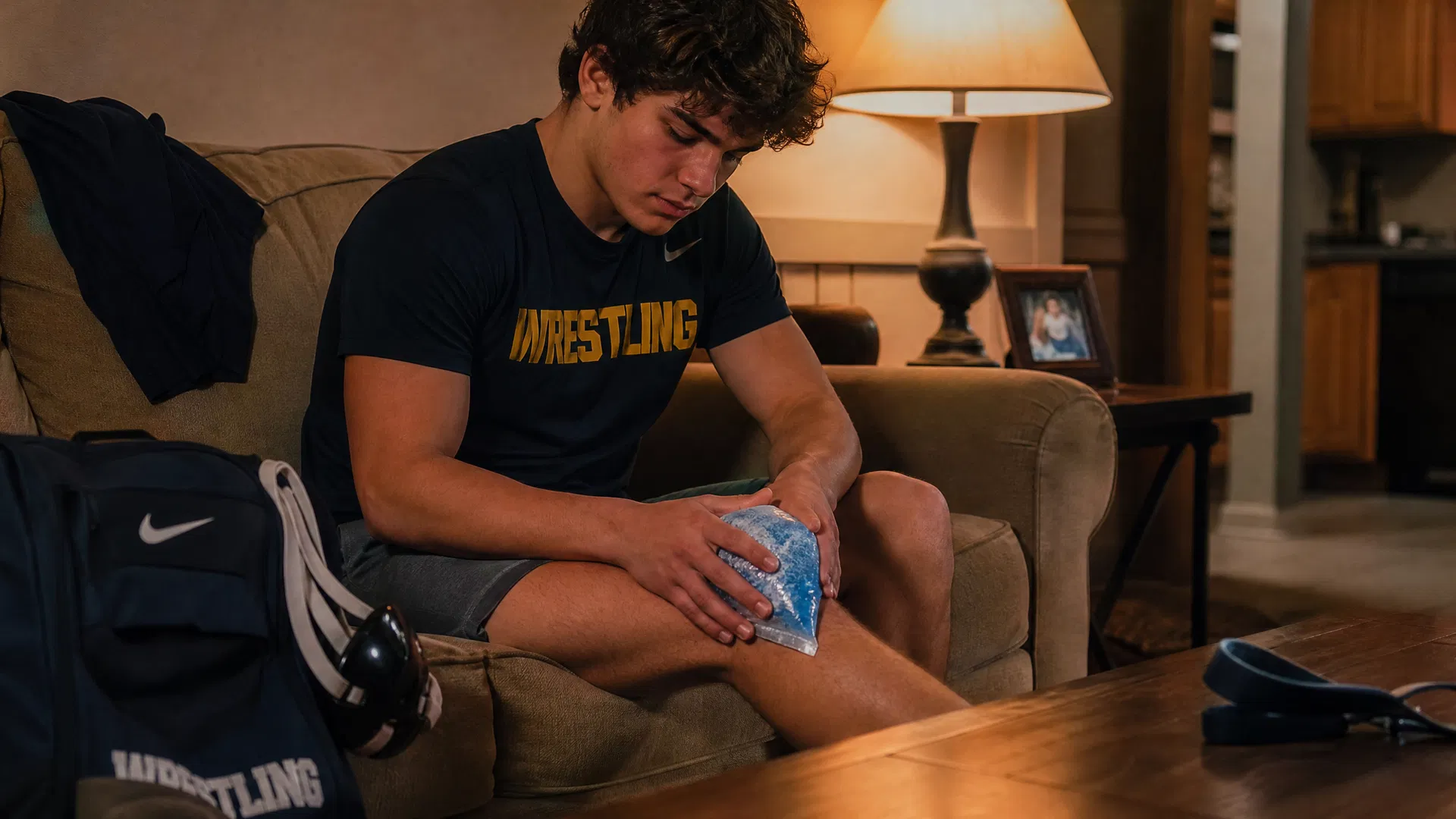
Post-practice recovery is where the real work happens
Refuel Properly
| Nutrient | Why it matters | Timing |
|---|---|---|
| Protein | Supports muscle recovery routines during heavy training. Follow your coach, athletic trainer, or sports dietitian for specific needs. | Within 30–60 min of finishing |
| Carbohydrates | Replenishes glycogen. Low energy can affect coordination and training quality in the next session. | With post-practice meal |
| Water | Many wrestlers start practice already slightly dehydrated from weight cuts. Rehydrating after is not optional. | Ongoing after practice |
Sleep Like Recovery Matters
| Metric | Figure | Source |
|---|---|---|
| Recommended nightly sleep for teenagers | 8–10 hours | National Sleep Foundation |
| Typical teen athlete actual sleep | ~7.2 hours | |
| High school athletes sleeping fewer than 8 hrs on school nights | 79% | Journal of Clinical Sleep Medicine, 2022 |
| Increased injury likelihood with fewer than 8 hrs sleep | 1.7× | Journal of Pediatric Orthopaedics, 2014 |
Sleep supports normal recovery, training adaptation, coordination, and next-day readiness. A hard two-hour practice creates fatigue; consistent sleep helps the athlete come back prepared for the next session.
When to stop home-treating and call a doctor: Swelling that doesn't decrease by the next morning. Swelling with warmth or redness. Any swelling following a specific incident — a hard fall, a collision, a pop sensation. A wrestler who is still limping 48 hours after practice.
Section 4 — The Recovery Habits Used By Successful Wrestlers
"The wrestlers who stay healthiest throughout a season aren't necessarily the toughest. They're usually the athletes who recover consistently after every practice — not just after they get hurt."
— Coaches at Black Sheep Wrestling Club

The athletes who make it through a full season healthy aren't necessarily the strongest or most naturally gifted. They're often the ones who treat what happens after practice with the same seriousness as what happens during it.
-
Scheduled recovery days
Not "rest days" as in doing nothing. Active recovery — walking, swimming, easy cycling — maintains blood flow and keeps connective tissue healthy without adding training load. For most high school wrestlers, one dedicated recovery day per week makes a measurable difference by mid-season. -
Mobility work done consistently, not occasionally
The muscles that most directly load the knee — quads, hip flexors, IT band — shorten and tighten during wrestling training. Ten to 15 minutes of hip and quad mobility after every practice consistently produces less knee soreness over a season. This isn't exotic sports science. It's maintenance. -
Targeted posterior chain strength work
Wrestling training develops the anterior chain heavily — quads, hip flexors, core. Hamstrings and glutes, which are essential for protecting the knee, often lag behind. Wrestlers who incorporate simple posterior chain work (Romanian deadlifts, hamstring curls, glute bridges) tend to have more knee resilience across a long season. -
Paying attention to warning signals early
High school culture around toughness can work against this. Where it breaks down is when "toughening up" becomes a strategy for ignoring a pain signal that's actually telling you something useful. The wrestlers who stay healthiest are the ones who can distinguish between the two.
Section 5 — When Additional Knee Support Makes Sense
Many wrestlers wear knee support even when they're not injured — not because something is wrong, but because wrestling puts the knees through hundreds of repetitive movements every week. Compression knee sleeves may provide warmth, a secure feel, light support, and improved joint awareness during long sessions and scrambles where awkward landings are more likely.

NEENCA ACE-51 Knee Brace

For wrestlers dealing with recurring post-practice soreness, returning to training after a tournament weekend, or simply wanting additional confidence during high-volume practice weeks, the ACE-51 provides targeted compression and supportive stability — without restricting the range of motion the sport demands.
- Full range of motion
- Targeted compression
- Mat-ready design
- Improved joint awareness
Note: A knee sleeve is not a treatment for an injury and should not replace rest, professional evaluation, or a recovery plan when something is genuinely wrong.
Section 6 — Recovery Is Part of Training
Most wrestlers focus on what happens during practice. The athletes who stay healthy through an entire season pay just as much attention to what happens after practice.
The goal isn't simply surviving today's workout. It's showing up ready for the next one — and the one after that. Getting through the regular season, the district tournament, and regionals without something breaking down in week 10 that could have been prevented in week three.
For parents watching their kid ice their knees on the couch at 9 PM: this is recoverable. Ongoing wrestling-related knee soreness should not be ignored. It usually means the recovery side of the equation isn't getting the same attention as the training side.
Start with the basics. Keep moving after practice. Refuel within the hour. Protect sleep like it's training. Watch the swelling. And if the soreness is starting to compound rather than clear — pay attention to that.
The mat will be there tomorrow. Make sure the knees are ready for it.
FAQ — Wrestling Knee Recovery
Is knee soreness after wrestling practice normal?
Mild soreness lasting 24–48 hours after a hard practice is common and generally not a concern. What warrants attention is soreness that persists longer than two to three days, worsens over consecutive weeks, or is accompanied by visible swelling.
Should wrestlers ice their knees after every practice?
Not necessarily. Ice is most useful when swelling is present — applying it to a knee that is simply sore but not inflamed provides limited benefit. When swelling does appear, 20 minutes of ice with the knee elevated that evening and the following morning is a reasonable first step.
How long should knee soreness last after wrestling practice?
Most training-related soreness improves within one to two days. If soreness is consistently present heading into the next practice — or increasing over the course of a season — the recovery routine needs adjustment, not just more ice.
Can a knee sleeve help during wrestling season?
Many wrestlers use compression sleeves throughout the season to provide warmth, compression, and improved joint awareness during training and competition. They're not a substitute for treating an injury, but for athletes managing general training soreness, a well-fitted sleeve can be a practical support option within a broader recovery routine.
When should a wrestler see a doctor about knee pain?
Persistent swelling that doesn't improve overnight, a locking or catching sensation, instability or giving-way, sharp pain on the inside or outside of the joint, or pain that has steadily worsened over several weeks — all of these warrant a visit to a sports medicine physician. Early evaluation almost always leads to a faster return to competition than delayed treatment.
What's the most common knee injury in high school wrestlers?
At the collegiate level, ligamentous injuries — particularly MCL and ACL sprains — account for more than half of all wrestling-related knee injuries. Meniscus tears and patellar injuries make up the bulk of the remainder. At the high school level, the knee is the second most commonly injured body part overall in wrestling.
Related NEENCA Resources
- NEENCA Professional Knee Braces & Sleeves
- NEENCA ACE-51 Professional Knee Brace
- Find Your Size
- NEENCA Support Technology
- How to Protect Your Knees During Wrestling Season
Sources
- Agel J, Ransone J, Dick R, et al. Descriptive epidemiology of collegiate men's wrestling injuries: NCAA Injury Surveillance System, 1988–2004. Journal of Athletic Training. 2007;42(2):303–310. pmc.ncbi.nlm.nih.gov
- Collins CL, Comstock RD. High school football, wrestling athletes suffer highest rate of severe injuries. American Journal of Sports Medicine. 2009. Via ScienceDaily
- Mangum K. Wrestling Injuries. drkevinmangum.com (citing NCAA Injury Surveillance System data)
- Tropp MA, et al. Return to Sport After Knee Injuries in Collegiate Wrestling. The Iowa Orthopaedic Journal. 2023;43(1):131–135. pmc.ncbi.nlm.nih.gov
- American College of Sports Medicine. Nutrition and Athletic Performance. Medicine & Science in Sports & Exercise. 2016;48(3):543–568.
- National Sleep Foundation. Teen Sleep Toolkit. thensf.org
- Milewski MD, et al. Chronic lack of sleep is associated with increased sports injuries in adolescent athletes. Journal of Pediatric Orthopaedics. 2014;34(2):129–133. Via Franciscan Health
- Swinbourne R, et al. Sleep habits of high school student-athletes and nonathletes during a semester. Journal of Clinical Sleep Medicine. 2022. jcsm.aasm.org

Written by Wilson John



Leave a comment
Este site está protegido pela Política de privacidade da hCaptcha e da hCaptcha e aplicam-se os Termos de serviço das mesmas.